From the Back of a Cow Paddock

Life without a reliable Internet connection sucks. There’s no other way to put it. I’m currently living on Information Superhighway rations; tiny little nuggets of wuh-wuh-wuhdotcom. The reason for this, and forgive me if I’m repeating myself because I can’t go and check what I have and haven’t already written about, is that we’ve recently moved house.

We were originally told that we’d be Internet ready from the moment we unpacked. Then we were told that we’d have to wait for the National Broadband Network to be rolled out in our area which, up until recently, was nothing more than a cow paddock (our area, that is, not the NBN). The thing is, “our area” technically already has the NBN. In fact, if we were leaving on the corner of our street, we’d already have it.

But because we live in the middle of our street, we’re a different stage of estate development. This meant that the NBN wouldn’t be supplied to us until February. Then it became March. At this stage, God only knows when it’s going to happen.

All of this is to say I’ve been a bad blogger (and Tweeter) and I’m sorry, but it may be like this for a while.

Which is a shame, because there’s been lots going on – like, for example, the fact that my wife and I went and saw Neil Gaiman at the Athenaeum Theatre in Melbourne last week. It’s always great getting the chance to hear him speak, as he’s an incredibly inspiring figure, but I have to say I still preferred the first time I saw him, which was at the Children’s Book Council of Australia conference in 2008.

His key note speech there would be a hard one to top, admittedly. He spoke of the link between innovation and imagination; the fact that everything that is or was or will be had to be dreamed of first, and that it’s in stories that dreams are seeded. Powerful words to tell people who’ve spent more of their lives being told to get their heads out of the clouds, I’m sure you’ll agree!

My fondness for his CBCA appearance has also probably been augmented by the fact that, this week, I ran across a review of Vanguard Prime: Goldrush that appeared in the November edition of  their official magazine, Reading Time. My publicist at Penguin supplied me with a scan of the review, but given that it’s in PDF format, is relatively large, and I don’t have the best connection for uploading at the moment, I may have to point you instead to the text version that’s available online here.

I have no way of expressing just how exciting it is to get such a great review from the CBCA. When I was a kid, I would always use their gold and silver cover stamps as a guide to what books I should read; to have popped up on their radar is such a thrill. To have them write such kind words about my book is a personal milestone.

The warm-and-fuzzies don’t stop there, though. I wrote previously about the event I had at Brunswick North Primary school and the fact that their teacher, Travis Berketa, had set up a reading library full of comics. Well, during the course of moving house I packed up a few of my old comics and sent them through to Travis’s class, and lo and behold if they didn’t send through the sweetest ‘Thank you’ card!

I’d hoped to be able to provide a photo of it, but once again the crummy Internet connection keeps me from doing that, so instead I’ll simply say thanks to the kids of Brunswick North Primary, and point you in the direction of Travis’s book Jack Majors: Superhero. If you enjoyed Vanguard Prime, I’m sure you’ll enjoy this too! Thanks, Travis!

So that’s just about everything I had to catch you all up on, other than to say that Vanguard Prime: Wild Card will be getting released at the end of February. I can’t wait until you all get the chance to read it. When you do, let me know what you think of it!

In the meantime, I’ll be here…in the cow paddock…waiting for the Internet to be switched on…
A Final Farewell to 2012

2012 was a big year.

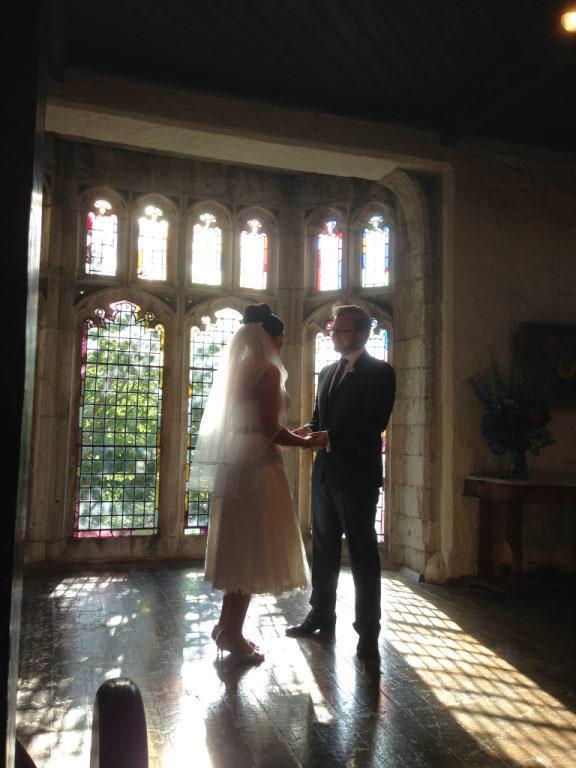
It was the year my first book was published. It was the year my fiancé and I moved into the first home that either of us had ever owned. And, on December 30, on our fifth anniversary, it was the year we got married.
409541_10151386117124610_809775696_n
Given that we’re both involved in publishing, our wedding had some bookish touches. Paperlovebuds provided bouquets and boutonnieres made from the pages of Pride & Prejudice
IMG_3878
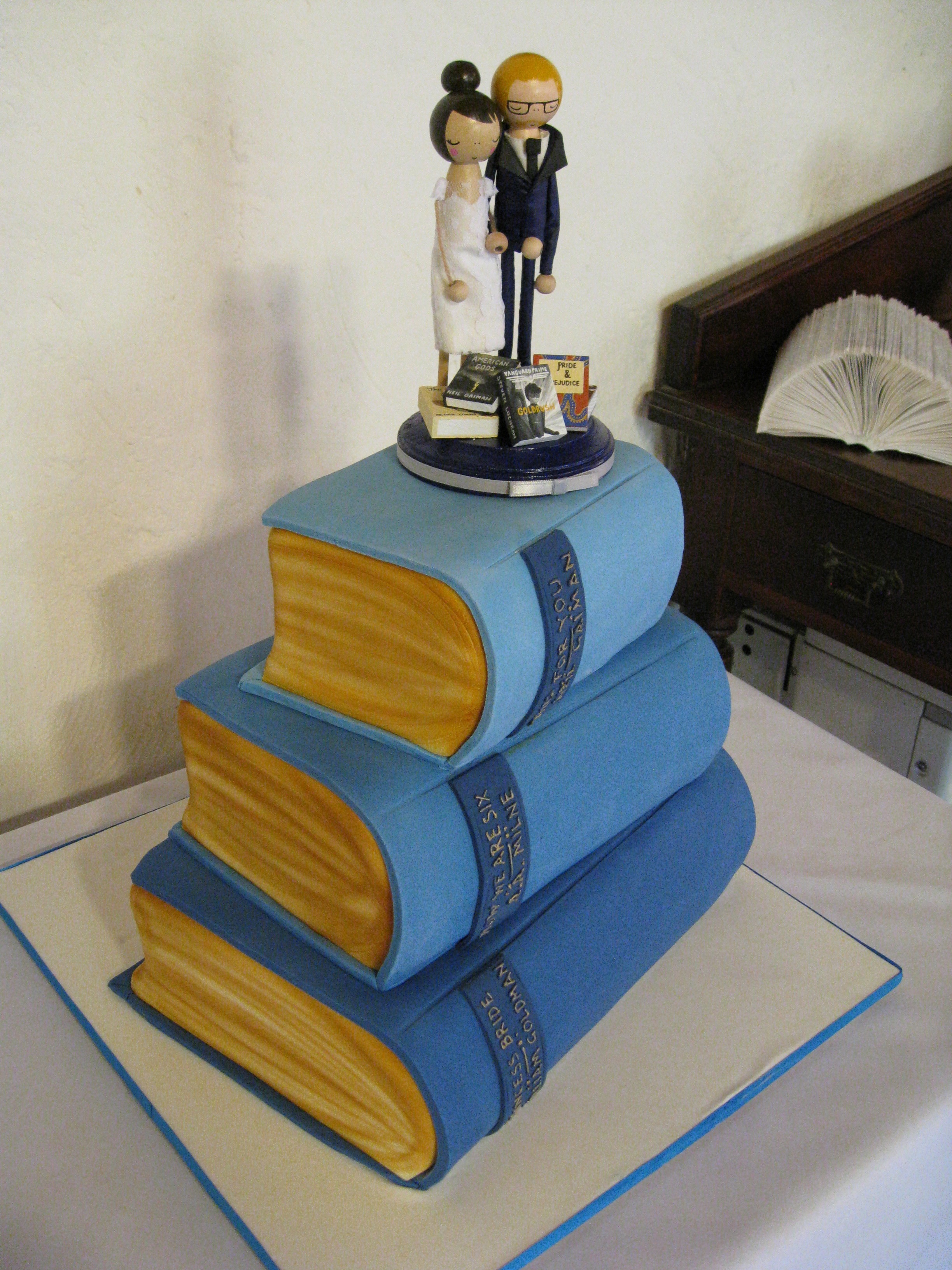
…while our cake topper was called “Love in the Library” and featured a title that readers of this website may be familiar with.

Yes, those books are made of cake.
@philipsainsbury captured a familiar title amongst the pile of books.

People don’t lie when they tell you how quickly your wedding day rushes by. It feels like it only happened yesterday but it was already over a week ago. And so far, this marriage thing is going swimmingly.

We’re planning to take a proper honeymoon later in the year, but in the meantime we settled for a week off, with a couple of nights spent in a hotel in South Yarra.

The summer heat lent itself well to seeing a few movies, which included The Hobbit: An Unexpected Journey, Argo, and the documentary Wonder Women! The Untold Story of American Superheroines, which proved to be a fascinating, emotional and inspiring look at the depiction of superheroines across pop culture, with a particular emphasis on Wonder Woman (of course). It’s been playing at ACMI here in Melbourne, but where ever you are I highly recommend checking it out.


And to add to my comic book geekery, I’ve also been reading Sean Howe’s Marvel Comics: The Untold Story, an engrossing and comprehensive history of the House of Ideas. If anyone out there knows a book that takes as detailed (and honest) a look at the story behind DC Comics, make sure to let me know!

So that’s it. 2012 is over. But there’s a lot to look forward to in 2013…including the release of Vanguard Prime: Wild Card in March! I can’t wait to get out and do some more events, as well as reveal more of the Knight of Wands’ history.

I’m also looking forward to finally getting a reliable Internet connection. But let’s not get too far ahead of ourselves…

Happy New Year, everyone!

Of (Un)Packing, Quantum Physics & Pooms

After months of preparation and packing, we finally moved into our new house last week. I had hoped to have an Internet connection set up by now, but we’ve built in a new area where we have to wait for the National Broadband Network to be rolled out. That won’t be happening until February, so that’ll unfortunately mean that I’ll be blogging less until then. That being the case, this post’s going to be a special extended edition…or some such.

As it turned out, the only day we had free to move was the same day that we had tickets to see Russell Brand performing at Rod Laver Arena. Now, Russell’s material is pretty adult (so I don’t expect any kids reading this to be familiar with it) and his persona is a divisive one (I thought he was a bit of an idiot until I actually watched his material) but something he discussed in his show touched on something that’s been of interest to me.

He talked about human sight being stuck between the ultraviolet and infrared spectrums, of our sense of reality being limited to what our five senses can perceive, and to imagine what it’d be like to have the antenna that would allow us insight into other, previously imperceptible dimensions of reality.

It’s the kind of thing I’ve read about in everything from the comics of Grant Morrison to the writings of Michio Kaku, and it’s the exact kind of thing I hope to include in Vanguard Prime one day. Will I get there? Hopefully. Will it be any good? No idea. But it’s an exciting idea nevertheless, and a strange one to encounter at a comedy show.

From one self-indulgent topic to another; I wrote a lot of poetry when I was a teenager. Correction – I wrote a lot of bad poetry when I was teenager. I did it without humour or irony. I did it to bare my soul. Until recently, I had forgotten what had prompted me to take up the quill and the inkpot to pontificate on my emotional suffering.

But in going through my book collection as part of the move, I stumbled across my copy of The Dead of the Night by John Marsden, part of his seminal Tomorrow series. Flipping through it, I was reminded of the character who had a predilection for poetry, with one of his poems serving as the book’s final lines. And that’s when I remembered…this is what inspired me. This is why I had started writing poetry.

To be fair, my poems were more like song lyrics. Super-earnest song lyrics about my sense of alienation and doomed romanticism. Basically, it was a coping mechanism, a therapeutic activity to deal with all the emotional feedback that comes with adolescence. My poetry-writing faded as I got older, finally killed by a university assignment where we had to write a poem and, in doing so, I was graded with the equivalent of a C minus. Ouch.

With that C minus came a self-consciousness, and I became aware of how ridiculous you can come across when you write a poem – a bad poem – and very humorlessly and pompously offer it as if you’re sharing some great insight to the world.

Case in point; Madonna.

I remember seeing this clip as part of a concert documentary she released a few years ago, and it characterised everything I found embarrassing about my own past with poetry, from the rhyming couplets to the ‘I’ve written a poom’ declaration that prefaces it. It made the whole practice feel ridiculous and ripe for mockery.

But then a few years later I saw Neil Gaiman giving an author talk, and he very unashamedly, very matter-of-factly recited some of his own poetry. From there, I’ve come to feel that poetry isn’t its own weird sub-category of writing, but another colour in a writer’s palette.

Poetry frees you from the rules of fiction and story, challenging your brain to move in directions it otherwise might not. As a result, I’ve once again started dabbling in poetry, looking to stretch my descriptive and tonal muscles, playing with words to make a song of them.

I’m a long way off from sharing any of it publicly, though. It’s strange how much more intimate poetry feels, and how much more vulnerable you feel as a writer when giving it to people to read. And that’s perhaps poetry’s greatest strength; it cuts away the artifice, leaving only pure meaning.

Wow…that got earnest. In any case, I recommend any young readers out there to give poetry a go. You may look back on it with embarrassment one day. But it’s worth it.

The Pitfalls of Repetition. Repetition. Repetition.

repetition 1

If you write for long enough, you’ll find that certain turns of phrase show up in your work with disturbing regularity. You might not notice it yourself. Not at first. It’ll sneak up on you like the Predator, all clicks and grrrs and shimmering photosensitive camouflage, with the neon green blood and the shoulder-mounted laser and…

I’m getting a little off-topic here.

In any case, it may take someone else pointing it out for you to become aware of it, or you’ll go over an old piece of work and find certain phrasings cropping up over and over again.

There was one book I read where the writer was constantly comparing things to bullets. It happened almost every other chapter (at least, I remember it happening every other chapter. It was probably more like four or five references across an entire book).

One or two bullet comparisons would have been fine but when it kept cropping up it became distracting, and you started to wonder how closely the editor had been paying attention (which is itself an unfair sentiment; the editor may well have pointed it out and the writer may have rejected any suggested changes).

When I wrote my first manuscript, I noticed certain words repeating themselves enough times that I cobbled together a phrase that used them all; “slowly spiralling towards an ocean of stars”. I used this phrase as a reminder that I shouldn’t lean on these words and pieces of imagery too much. And this breaking of bad habits continues to this day; my editor and I are currently going through Vanguard Prime: Wild Card, and it was pointed out to me that I had to watch my use of the word “however”.

But in addition to that, I also noticed my overuse of the word “cannon” – not just in this book, but across all the Vanguard Prime books I’ve written so far. And that’s where the real challenge lies. Avoiding repetition in a single book is relatively easy, if you pay close enough attention. Avoiding repetition across a series of books? Across an entire body of work? It’s a daunting prospect that can almost paralyse you. You become so anxious about avoiding not only established cliches but your own cliches, while also not straying into purple prose, that you risk your writing becoming little more than the records of a court stenographer.

These are the things that are on my mind as I put the edit for Wild Card to bed and start to focus again on writing Book 4. It’s the kind of neurotic writer nonsense that’s generally better off left to midnight fever dreams and stress binging…but what’s a blog for but to provide cheap therapy?

The Importance of Being Edited

Today’s my last day as Inside a Dog’s Resident Author. You can read my final post here. It’s been a lot of fun waffling on about storytelling and any topic that crosses my mind, and has convinced me that I need to write a few more posts here about the world of publishing.

There were a few times over the past month that posting a new entry proved to be a challenge, mostly because I’ve also been in the process of editing Vanguard Prime: Wild Card.

The process starts like this; Katrina, my editor, reads through the manuscript and makes notes as she goes, using Track Changes to suggest changes, ask questions, and point out any potential plot holes or inconsistencies.

When she’s finished, she emails me the marked-up Word document. I then go through, accepting or rejecting her suggestions, answering her questions and posing any of my own. By the time it’s done, the Track Changes document is a multi-coloured mass of deleted text, added text, and comment boxes.

The coloured boxes on the right are the notes between the editor and me.

I email the marked-up manuscript back to Katrina. She goes through, making the changes that I’ve approved and editing any new text that’s been added between drafts. This is incredibly helpful as my syntax can be unfocused and couched in far too many qualifiers. Katrina takes a machette to my puffed-up narration, cutting to the core of the idea I’m getting at. If there are any self-publishers reading this, I strongly recommend paying for a top-notch editorial service. It won’t be cheap, but publishing a book without an editor’s input is like walking outside with your fly undone and spinach in your teeth.

The manuscript is emailed back to me once again, looking far more tidy than it did the first time. I read through the whole thing a second time (well, I skim through it at this stage), making sure I’m happy with all the changes, and when I’m done I email it back to Katrina. At this point, the designer steps in to put together the page layout, adding fonts and dinkuses (dinkae? What’s the plural of dinkus?) and making sure everything fits and looks neat.

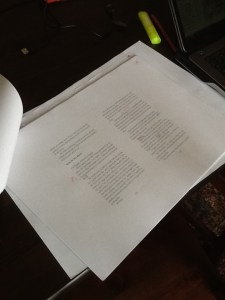
Katrina prints the pages off on A3 paper, with two book pages to every printed page, and posts it to me. We both read it through, as does a proofreader, and this is my last chance to make any changes. Generally these changes are about sentence structure, as things are too advanced at this stage to focus on structural issues (though if you spot a plothole that needs a line of dialogue added to address it, that’s still fine).

I use a highlighter and a red pen to mark down problem sentences and changes I want to make, marking every page where a change has been noted with a red X at the top right, so I know what pages to jump to when it comes time to email Katrina again.

As we’re now working off hardcopy, I type up an email where I outline each of the changes I’d like to make, a sample of which reads like this;

Page 4.
Original line: He’s been playing the cello ever since he was a kid
Change to: He’s been playing the cello all his life

Every step of the process has a two-week turnaround time, so the deadlines can get tight. I’m currently writing up the email with all the changes to make, which is due Monday (thankfully, I’m on target to get it in on time). After that, my publisher might also make suggestions about any possible changes to make, but otherwise this is the final text, which is put together by the designer and sent off to the printer to be published as a book.

So that’s what I’ve been doing at the same time as my Inside a Dog residency.

But in addition to that, my fiance and I are set to move house on Friday, which is always a much more involved process than you remember it being. Oh, and we’re getting married at the end of December, so we’ve had a few things to do on that front as well. And I also work full-time.

…….Just typing all that makes me feel exhausted!