5 Things I Didn’t Know About Being an Author

Even though I’ve worked in the publishing industry for over five years now, there were still a few things that took me by surprise when my book was picked up. In the interest of helping out other aspiring writers, here’s five things I learned when I went from working with books to writing them;


1. You have to provide your own author photo.

My contract is a pretty standard one, and it details that providing an author photo is my responsibility and is to be done at my expense. I don’t know if there are any authors to whom this stipulation doesn’t apply.


Being a cheap cuss, I solved that issue by getting my photo taken by my fiance in our living room. We had to do this across two nights because the first evening was spent working out the best way of taking the photo. It seems like an easy thing to do until you’re faced with the prospect of it being disseminated across the Internet and printed in the paper.


We used two different cameras, both of which we had a lot of trouble getting focused correctly. When the image wasn’t blurry, I would generally have a weird expression on my face. When I didn’t have a weird expression on my face, the light wasn’t right (or it was reflecting in my glasses). I’m not that comfortable about getting my photo taken in the first place, so the entire process was a special kind of torture, and that showed in my face for most of the pictures.


Natural light ran out before we got the photo on the first night, so we gave up and tried again the next evening. Thankfully, we eventually got a photo that was decent. It was a little blurry but I didn’t mind that as it gave the whole thing a vaseline lens feel. Of course, that was a rookie move on my part, as this image needed to accompany print interviews and it’s not a great look for your photo to be out of focus.


When that became an issue, I had to quickly get another photo taken with help from a friend at work. The second time was almost as difficult as the first! One of these days I’ll have to get a professional shot taken, but in the meantime you can learn from my mistakes and get one done by a photographer in advance, because you never know when you’ll be asked for it!


2. You’ll need to practice your signature (as well as have some witty things to inscribe!).

My penmanship is terrible, so it was strange to think that people may want me to write something in their books. Also, my signature is little more than a few slanted pen strokes, which worried me that people would feel cheated if all I gave them was an illegible scribble in their book, so I sat down and practiced a clearer signature.


Not only did I come up with a legible John Hancock, I also worked out a few phrases to offer people. But one thing I didn’t count on was inscribing books for people I knew! Many friends and family at the Vanguard Prime: Goldrush launch were left with bizarre things written in their books as I desperately tried to figure out something witty to scrawl out. Trust me, it’s hard to do when you’re trying to maintain a conversation at the same time! Do your best to work it out in advance!


But I think the most important thing in all this is to practice your pen(person)ship. You may feel like it’s redundant given how much work is done on computers these days, but there may come a day when you need to write things down in longhand. You don’t want people thinking a kindergartener has gotten hold of the Mont Blanc!


3. You’ll need to get good at talking to people and crowds, and you’ll need to do it fast.

You may have grown up wanting to be a writer after finding it difficult to connect with people. You may have done it as a way to escape the hardship you faced in the everyday world, to assuage the anxiety that socializing caused you. I know that’s what I did.


But the fact is, there’s no greater advocate for your book than you. And if you want it to be a success, and if you want to get the chance to write more books, you’re going to have to go out there and talk to people. And you’re going to have to be good at it.


If this is a weak spot for you, your publisher may provide media training for you. With budgets being what they are these days, however, the chances of that aren’t great. I’ve never been what you’d call a social butterfly, but one way I found of overcoming my stage fright was through drama classes.


I took drama in high school and the lessons I learned there have carried through to this day. Whenever I’m in a situation where I have to speak in front of a large crowd and I’m feeling nervous about it, I do two things. The first thing I try to do is harness that nervous energy. Use it as a fuel to overcome your obstacle.


The second is to imagine that this isn’t you. That this is a performance you’re putting on, a character you’re enacting, and that even if you “fail”, it’s not really you who’s failing. It may sound slightly mad, but it works.


I thought I’d have to prove my abilities to speak in front of crowds to my publisher. And that’s kind of what happens, but only by having your publisher throw you in the deep end and seeing if you swim. And you owe it to yourself to swim.


So whenever you’re asked if you want to appear somewhere or participate in some event, no matter what it is and no matter how nervous you may be about it, you have to say ‘yes’.


(And as a final note on this topic; make sure to work out a way to encapsulate your book that sounds interesting, and that can be expanded upon if necessary. You need to convince whoever’s listening that your book is worth picking up, especially when they’ve never heard of it before. I’m still working on this one!).


4. Even when you’ve “made it”, you still haven’t made it.

When I was toiling away on my manuscript, I imagined what it would be like to see my book on store shelves and the feeling of perfect contentment that would wash over me as a result. That was the dream that kept me going. It’s no doubt the dream that keeps a lot of people going.


But here’s the thing; even when you achieve that, you still haven’t “made it”. You may have achieved the status of “author”, but now you need to retain the status of author. The goal posts never stop shifting. The first goal is to get published. The next goal is to keep getting published. You need to make sure you’re in this for the long haul, because if you aren’t it’s easy to become one of those many anonymous authors whose books line the walls of second-hand shops, never to be heard from again.


5. What a dinkus is.

You know that little emblem that will sometimes be used in books to break up the text? In the Vanguard Prime series, it’s the team’s insignia. That’s a dinkus. The publishing team works together with the author to work out what that little symbol will be. It’s also my new favourite word. Dinkus, dinkus, dinkus.

Awesome.


Festivals and Filming

I covered it briefly in my last post, so you already know that the weekend just gone was a doozy.

It all kicked off with the Ballarat Writers and Illustrators Festival on Saturday. I arrived early enough to be included in a tour of the Ballarat Mechanics’ Institute – the festival’s venue – which has nothing to do with cars and is, in fact, one of the oldest buildings in Ballarat.

The Ballarat Mechanics’ Institute (photo from their website).

Jill Blee, President of the Institute, showed us the many beautiful rooms the building had to offer while detailing its history for us, which included a book collection that stretched back to the 1700s and subterranean shop fronts that still stand, windowless now, beneath Sturt Street. The entire time I was making mental notes to use all this as a story setting in the future, but given that I was at a writers’ festival I’m sure I wasn’t the only one. In fact, I know I wasn’t…

Author and fellow panelist Michael Panckridge was on the tour with me, which meant that if we were late in getting back that two-thirds of the panel would be MIA. Thankfully we returned in time, meeting third panelist and author Hilary Badger, as well as our moderator Maryanne Ross.

We each discussed our paths to publication, our experiences in the industry, the challenges of writing a series for younger readers, and finally fielded questions from the audience. It was the first time I’ve ever participated in a panel rather than watching one, and was such a great experience that I can’t wait until the next time I get to be on a panel…festival organisers beware!

The next morning my fiance Simone and I set our alarm early(ish) to watch my TV debut, after recording an appearance on Kids’ WB a fortnight earlier. It was a lot of fun, especially given that I was already a fan of the show and couldn’t believe I was getting the chance to appear on it.

Me with Kids’ WB hosts Lauren and Andrew (in his superhero disguise).

The hosts, Lauren Phillips and Andrew Faulkner, were both very friendly and welcoming, as was Allison the producer and all the crew. The studio, which looks big on the screen, turned out to be the corner of a room hidden behind a giant sliding door in the lobby of the Channel 9 building in Melbourne.

Arriving there, I was quickly whisked away to get my make-up done, which was thirty seconds of having my face dusted as Julia Morris sat in the chair beside me cracking jokes about Justin Bieber (no Wikipedia bio necessary). It was so surreal and inexplicable that I’m still not entirely convinced that it wasn’t a dream.

I reported back to the studio, where we managed to get the interview done in two takes (with the second take being done to get a close-up on the book as I pointed to it). The second segment, where Andrew and I competed in a quiz, was done in one take, with Andrew and I chatting about video games between set-ups and Lauren revealing that the first time she’d appeared on TV was when she was nine-years-old and Catriona Rowntree interviewed her for What’s Up Doc?, the ancestor to Kids’ WB that people of my generation still remember fondly.

We wrapped ahead of schedule, finishing up just as I was getting a taste for it, the high school drama geek that still dwells inside me having reawakened. Of course, just because I enjoyed the filming didn’t mean I felt any less self-conscious as we watched it air on Sunday morning. Simone had to keep me from leaving the room more than once, despite my insistence that bagels needed to be buttered and tea had to be poured!

Even as the segments were airing, traffic on this website was seeing a huge spike. If you’re one of the new visitors that came along after watching the show, let me take this chance to say welcome! And for those of you who didn’t get to see it, Kids’ WB uploads a lot of its segments onto their website. Once it’s up I’ll make sure to link to it.

So with that weekend over and done with, things will be a little quieter for the time being. The next event I have scheduled is an in-store appearance at Dymocks Southland on September 22nd (details on the Events page). Make sure to come along and say hi! And in the meantime, I’ll continue looking for a spot to keep the Pillow Pet I won from the Kids’ WB. They’re surprisingly huge and tricky to store, even if they are delightfully soft to the touch.

…that sounded weird.

‘Til next time.

What’s Up, Doc?

Today I’m heading off to the Ballarat Writers and Illustrators Festival to participate in the Action, Action, Action: Sports Stars to Superheroes panel with Michael Panckridge and Hilary Badger. It’s going to be my first writers’ panel and I’m very much looking forward to it. If you’re heading to the festival hopefully I’ll get the chance to see you there, but if you’re not and you want to see what my giant head looks like in motion and with words coming out of it, then you’re in luck!

Because tomorrow morning on GO! I’ll be making on appearance on Kids’ WB alongside hosts Lauren and Andrew. I’m going to be in two segments; one where we have a quick interview and the second where I get to take part in a superhero quiz against Andrew. If I’m not mistaken the segments will be appearing before Young Justice and Batman: The Brave and the Bold (so somewhere between 9am and 10am). So get your cereal bowl filled and make sure to tune in to watch me squeeze a rubber chicken (that’s not a euphemism).

Yes, that’s a chicken I’m holding.

In other, non-chicken-related news, I thought it was worth mentioning that I delivered the manuscript for Vanguard Prime: Book 3 this week. It was due on Friday but I got a bit antsy and sent it in early on Wednesday. We’re only about to start editing Book 2, so Book 3 is still a long way off (it’s scheduled for release September 2013), but this should give you an idea of just how far in advance things run in the publishing industry!

I’m pretty sure that’s everything I had to catch you guys up on. I need to go finish ironing my shirt and hit the road for Ballarat!

‘Til next time.

The Ideas Shoppe: The Making of a Superhero (Part 2)

Continuing my look at the creation of the Vanguard Prime team, I thought it was best to present the other junior member – Machina.


I knew it was important to include more than one teenage member of the team, and I also knew it was important to make that other member a girl. Machina arrived in my head almost fully formed. I knew I needed a “tech-head” for the group, and an armoured one would make a contrast to all the other members. The name popped out at me almost immediately, which I took as a sign that it should be a placeholder until I came up with something “better”, but ‘Machina’ quickly grew on me and so the name stuck.


I’ve been asked more than once how it’s pronounced. Technically, it should be “mack-in-a”, but I have to admit I pronounce it “ma-sheen-a”. The disparity exists because the name comes from “deus ex machina”, a term which translates from Latin as “god from the machine”. To quote Wikipedia (always an intelligent-sounding thing to say) it’s “a plot device whereby a seemingly unsolvable problem is suddenly and abruptly solved with the contrived and unexpected intervention of some new event, character, ability, or object”.


I half-named the character after this term because her power could become an easy “Get Out of Jail Free” card and I wanted a reminder to not let that happen – at least not too much. The mispronunciation comes into play because I just think it sounds better. A writer’s heart is a fickle thing.


As far as her character itself is concerned, I drew on all the slightly older teen girls I remembered from when I was young who all seemed so much more sophisticated than I was and were all highly terrifying. Admittedly, there’s also a dash of Hermione Granger in there, as well as a large helping of Asuka Langley Soryu from Neon Genesis Evangelion, though I wasn’t conscious of either of those influences at the time. It’s only in retrospect that I realise how much those characters factored into Machina’s inception.


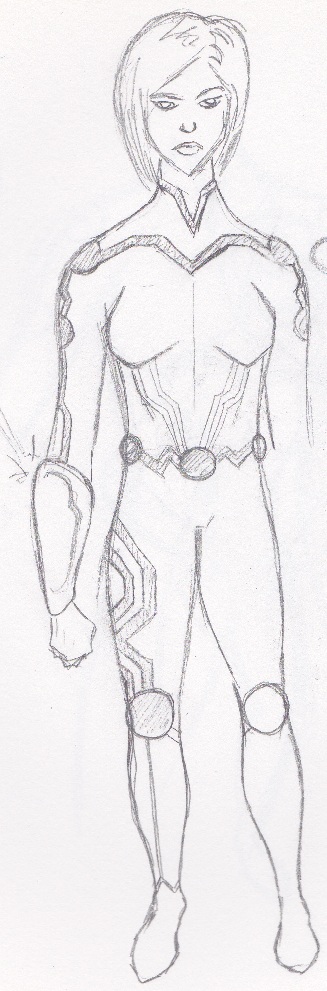
Design-wise, I envisioned Machina in a white V-suit that matched my original idea for Sam’s, with her outfit made-up of purple circuit-patterns where Sam’s was gold. Picturing actors in the role of my characters always helps me in creating them. I imagined Machina as a cross between Brie Larson, Alison Lohman and Stephanie Bendixsen, only British, and sketched out a rough idea of what she might look like to get a handle on describing her.

One of the first Machina sketches, where I was working out how the circuit pattern might work.
A later sketch, where the circuit patterns are starting to get out of hand.
My final, streamlined design, where the circuit patterns manage to form ‘M’s and ‘V’s at the same time.

All of these designs suffer from the obvious problem that I can’t really draw but they helped me to envision the character, which in turn informed my description of her.


Eventually, my final sketch was passed onto the book’s design team. Just as with Sam, it was thought a white suit wouldn’t strike the right image, so the colours of Machina’s outfit were swapped to black and purple. Her character is very much retained, however. Interesting note: while I drew on the actresses I’ve listed for my mental image of the character, the book’s designer used Michelle Williams as a starting point. I remember being really impressed with the designer’s insight when she told me that.

The final Machina design, where she demonstrates her armour-forming power.

Of course, all this gives an insight into the visual of Machina, but not her character. For that, I’d like to point to a couple of moments from the book.


One of those moments is where she’s talking about how she came to be a member of the team, and how that relates back to the relationship she has with her family. Machina doesn’t come from the same kind of background as Sam does. Though she by no means had a “bad” upbringing, I imagined her parents to be very distant people who’d had a daughter almost as an afterthought. The fact that she prefers to go by her superhero alias rather than her civilian name goes to show just how alienated she is from her family.


The other moment – and it’s a tiny one- is where Sam is listing the objects he sees when looking around Machina’s room and he notes all the stacks of CDs. It’s not commented on, and nobody has mentioned it to me as yet, but it seems odd in this day and age that a teenager would have need of physical albums, especially a teenager as tech-savvy as Machina.


I imagined these CDs to have been handed down to her from her older brother – the artifacts he passed on to help her cope when he left home and she was still stuck with their parents. It’s why she’s so knowledgeable and snobby about music, but it’s also why she’s standoff-ish with Sam when he joins the team; she’s created a new family for herself with Vanguard Prime, a family where she has a distinct role and purpose, and suddenly a new baby brother has come along to potentially usurp that.


She keeps those CDs as a tangible connection to her brother, using them as a security blanket in a way. I never actually address that in the book and I don’t know if I ever will during the course of the series, but it’s touches like those that writers create for themselves – if no one else – as they imagine the interior life of all their characters.


Since the book’s come out, I’ve been a lot asked about the relationship between Machina and Sam. I think the best answer I can give is that the dynamic between them is a complicated one, and that it will only grow more complicated in time to come, especially as Book 2 will throw a spanner in the works that nobody’s really counting on at the moment.


What is that spanner? You’ll have to wait until March 2013 to find out. But if you want to learn a little more about Machina, make sure to check out her bio here.


The Ideas Shoppe: The Making of a Superhero (Part 1)

When I was first outlining the story that would become Vanguard Prime: Goldrush, I had nothing but a few spare ideas of what I wanted it to be, which I gathered together in a file on my computer called “YA superhero story”. Those ideas included the goal of creating superhero characters that felt authentic, that could be a main character in their own right, and that would have a certain weight and sense of history to them.


Eventually, I’ll explain how I come to create each member of the Vanguard Prime team, but for this first post in the series, I thought the best place to start was at the heart of the team with Goldrush himself.


By the book’s own nature of being a Young Adult story, I knew I had to have a young character at the centre of events. I wanted the main character to be relatable, so he had to have a fairly basic power that had the potential to develop over the course of the series.


My first idea was to draw on the characters I created when I was a teenager (and an aspiring comic artist), which included ‘Soundstorm’, a superhero who could absorb sound and transform it into energy. I toyed with this idea for a while, before eventually dismissing it as unworkable.


The next power I considered was a stranger one; a hyper-kinetic ability that would give the character the ability to bounce and ricochet from one surface to another, like a human superball. This seemed too difficult a power to encapsulate for a reader unused to superhero stories, so once again I canned it.


All the while, I was trying to work out what the character’s visual motif would be. Superheroes need a strong visual “gimmick”, for lack of a better word. The most famous superhero characters have an iconic appearance that generally stems from a simple concept; a man dressed up as a bat or a spider, a soldier dressed in his country’s flag, a speedster who uses bold colours and lightning bolts to convey motion (Superman gets a pass on his visual being so generic because he’s the guy from which all other superheroes stem).


Drawing from my old note books again, I found ‘Goldrush’ listed in the ranks of a superhero team I’d generated names for but never created any characters to go with them. Turning the name over in my mind, I realised it was perfect. It gave me a colour scheme to work with, it suggested a power, and it stuck in the memory. It sounded a little goofy, but in a cool way that the best Gold and Silver Age superhero names sounded.


But why “gold”? Just because of his costume? And what were the limitations of being a speedster? Would he need to wear a helmet to protect himself from the velocity he’d be travelling at? I sketched out an idea of what the character might look like with a mask, guarding him from both g-forces and the media’s cameras (you’ll have to forgive the roughness of the drawings – there’s a reason I gave up on trying to be an artist).

The first sketch of the character that would become Goldrush

It just didn’t look right, though. I had run into the same problem that Hollywood does whenever it produces a movie about a masked superhero; you limit the range of emotion you can show. Not that that’s much of an issue in prose, of course, but there was always the book cover to consider.


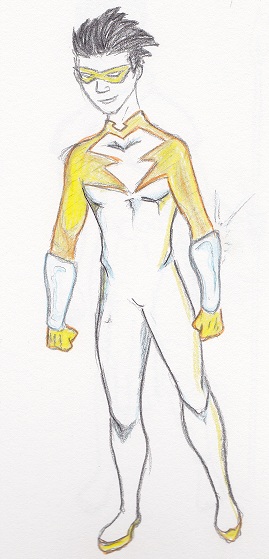
I took another pass at the design, deciding on white and gold as the colour scheme to help differentiate the character from the Flash. I liked how sunny and positive it was, but felt it still looked cool. Having decided on the name Sam Lee, my character was formed. Now I just had to write about him.

Goldrush as he was first envisioned.

Three years later, when my book was finished and had been picked up by Penguin, the design process for Goldrush began all over again. The designer and publisher felt that a mostly-white costume wouldn’t work, and asked how I’d feel about swapping the suit’s colours. At first I was unsure, but then I sketched out a rough idea of what it might look like and found myself pleased with it.

The inverted Goldrush uniform, incorporating ‘V’s into the design.

From there, the illustrator and designer took over. The first step was in finalising Sam’s look, with the illustrator providing a preliminary design that I can’t post now, but hopefully at some stage I will. It retained some of the white elements, coupling them with glowing neon and a black base layer that was visually stunning, but a little busy.


Working with that feedback, and moving in a darker, more realistic direction, the illustrator took a second – and final – pass at the costume. Streamlined, strong, futuristic, Goldrush’s V-suit (as the team’s outfits are called in the VP universe) looks like what an expert costume designer would create for the big budget Hollywood adaptation of the book.

The finalised Goldrush design, as featured on the book’s cover.

But most of all, it retains the most important elements that I’d aimed for when first coming up with the character; it has a strong visual theme, it identifies him and the team he works for, and most of all…it looks cool! Beyond his visual appearance, however, Sam also had to be sketched out as a person.


Once again drawing from my own adolescence, I took the pressure and intimidation I felt in transitioning from primary school into high school and multiplied it a thousand times. I knew I didn’t want to refer to my own experiences too much, however, as I’d basically included myself as the main character in the first manuscript I’d tried to get published, and it hadn’t turned out well.


So I thought through Sam’s life and his predicament – wouldn’t it make things harder for him if his life back home was happy, even idyllic? How would his parents feel about shipping him off to what amounts to the most high-pressure military school in the world? And what was the incident that saw Sam gain his powers? What got him to that moment, and in what ways was he changed after it?


These were all the questions I had to ask and answer in creating Sam, and they’re the same questions that are posed through the course of the book. Because it’s not just the flashy costumes that draw us to superhero characters, it’s the people beneath them.

…which sounds a little dirty, now that I think about it.


I hope you’ve enjoyed this peek behind the publishing curtain. Make sure to come back for Part 2 in the Making of a Superhero, to be posted…well, whenever I get around to it, really.


‘Til then.